
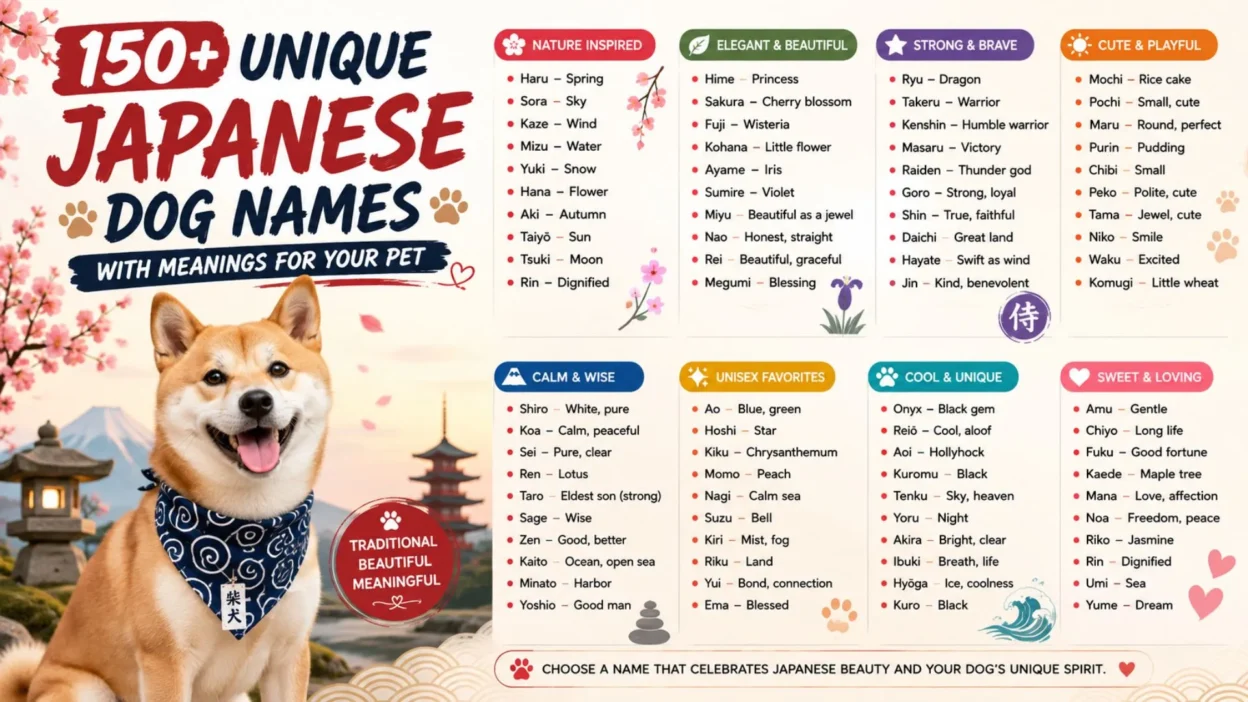
Choosing a name for your dog is special. It reflects their personality and your bond. Japanese dog names offer unique sounds and deep meanings. They work well for any breed or size.
Many pet owners love Japanese names today. These names are often short, melodic, and powerful. This guide shares over 150 ideas. You will find traditional, modern, cute, and strong names below.
Why Japanese Names Are Perfect for Dogs
Overview: Japanese names sound beautiful and carry rich meanings.
Japanese culture values nature, honor, and simplicity. These values shine in their naming traditions. A name like “Sora” means sky. “Kumo” means cloud. Such names feel gentle yet meaningful.
Dogs respond well to short vowel sounds. Japanese words often end with “a,” “i,” “o,” or “u.” These endings help dogs recognize their name faster. Plus, Japanese names avoid harsh consonants.
You can honor your dog’s spirit with these names. Whether playful, loyal, or calm, there is a perfect match. Many owners also appreciate the uniqueness. Your dog won’t share a name with three others at the park.
The Cultural Beauty Behind Japanese Dog Names
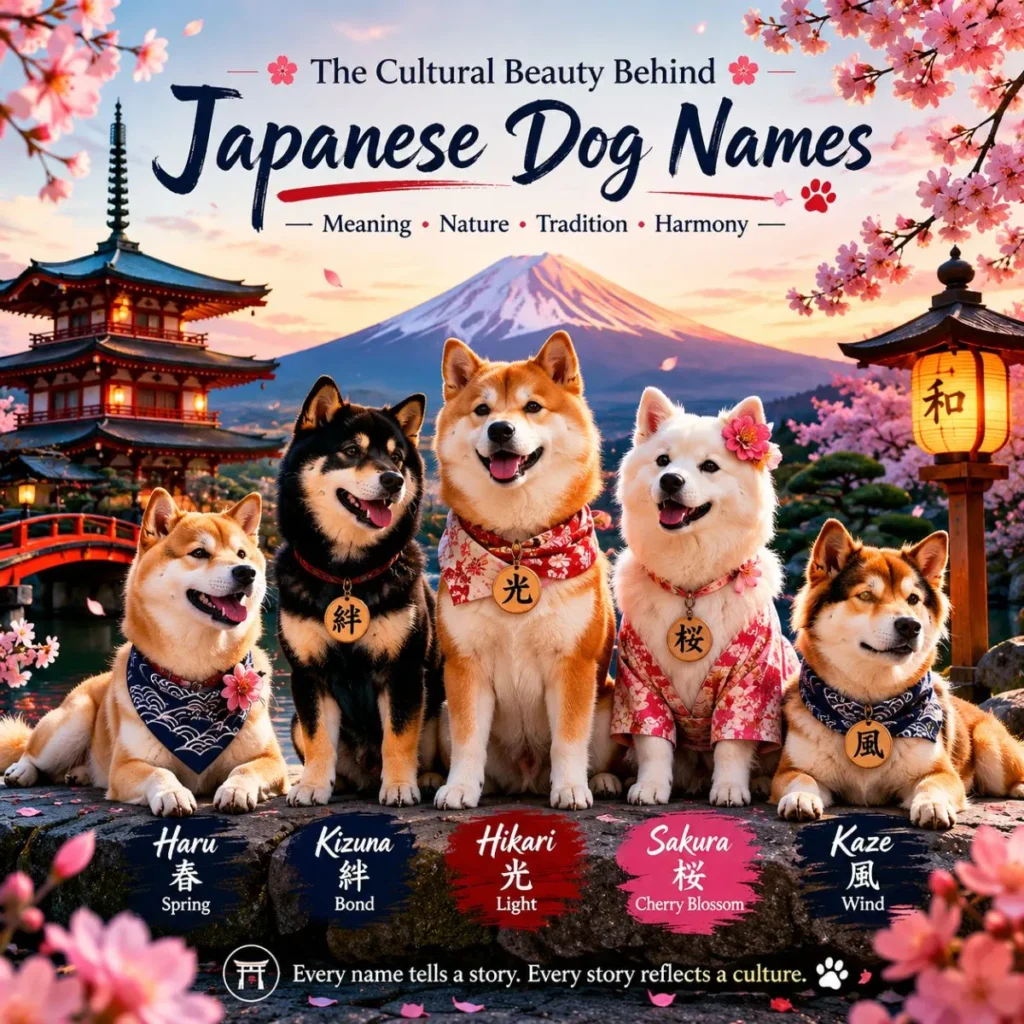
Overview: Japanese names often come from nature, virtues, or folklore.
In Japan, names hold power. People believe a name can shape a being’s future. Dogs are family members, so their names matter. Traditional Japanese dog names include “Taro” (firstborn son) or “Hana” (flower).
Some names come from samurai virtues. “Yuki” means courage or snow. “Ken” means healthy and strong. Others come from Shinto beliefs. “Inari” is a fox deity, but works well for clever dogs.
Modern Japanese names borrow from pop culture. Anime and manga inspire names like “Goku” or “Pochi.” But traditional names remain very popular. The key is finding a name with a meaning you love.
How to Pronounce Japanese Dog Names Correctly
Overview: Simple pronunciation rules help you say names right.
Japanese is a phonetic language. Every letter is pronounced clearly. Vowels are short and crisp. “A” sounds like “ah.” “I” sounds like “ee.” “U” sounds like “oo.” “E” sounds like “eh.” “O” sounds like “oh.”
Avoid stressing any syllable. Japanese has no strong accents. Say “Ka-i” as two even beats. Not like “Kai” in English. Practice with “Sakura” (sah-koo-rah). Keep each vowel clear.
Double letters mean longer sounds. “Kuma” (bear) vs “Kumma” (not a real word, but example). “Totto” has a small pause. Listen to online clips if unsure. Your dog will learn the sound quickly.
Popular Japanese Dog Names and Their Meanings
Overview: These names are common and easy to remember.
Some names appear on every Japanese dog name list. They are popular for good reason. They sound lovely and work for most dogs.
- Hiro – generous, tolerant
- Mochi – rice cake, soft and sweet
- Sakura – cherry blossom
- Kai – ocean or forgiveness
- Aki – autumn or bright
- Nori – belief or seaweed
- Yuki – snow or happiness
- Ren – lotus or love
- Sora – sky
- Momo – peach
These names are easy to say. They have positive feelings. Try calling “Mochi!” in the park. It sounds friendly and fun.
Japanese Dog Names for Male Dogs
Overview: Strong and masculine names for boy dogs.
Male Japanese names often end with “o,” “ro,” or “ki.” These endings feel firm and steady. They suit larger breeds or confident small dogs.
- Haruki – springtime tree
- Kaito – ocean and flying
- Riku – land or shore
- Kenji – intelligent second son
- Daiki – great glory
- Takumi – artisan or skillful
- Sho – to soar or fly
- Katsu – victory
- Jiro – second son
- Goro – fifth son
Use these for loyal protectors. A Rottweiler named “Kenji” sounds noble. A Shiba named “Katsu” fits a little fighter.
Japanese Dog Names for Female Dogs
Overview: Elegant and gentle names for girl dogs.
Female Japanese names often end with “ka,” “ko,” or “mi.” They sound soft and melodic. These names work well for graceful or sweet dogs.
- Hana – flower
- Mika – beautiful fragrance
- Yuna – gentle or kindness
- Rin – dignified or cold (depending on kanji)
- Aiko – little loved one
- Koko – here or stork
- Mei – bud or life
- Sachi – child of bliss
- Emi – blessed with beauty
- Mai – dance or linen
These names feel warm and kind. A Golden Retriever named “Hana” sounds gentle. A Chihuahua named “Mika” sounds precious.
Cute and Short Japanese Dog Names
Overview: Brief names are easy for dogs to learn.
Dogs respond best to one or two syllables. Short names grab attention faster. Japanese offers many tiny, cute options.
- Pochi – common dog name like “Spot”
- Maru – circle or perfection
- Chibi – small or tiny
- Tama – jewel or ball
- Bu – part or section (often part of longer names)
- An – peace or quiet
- Uta – song or poem
- Kii – from kiiro (yellow)
- Puku – fluffy or chubby
- Run – run or swim
These names work for any breed. “Chibi” suits a tiny Pom. “Maru” fits a round, happy Corgi.
Strong Japanese Dog Names for Powerful Breeds
Overview: Bold names for big or brave dogs.
Some dogs need a name with weight. Think Akita, Tosa Inu, or German Shepherd. Japanese history offers warrior names.
- Raiden – thunder and lightning
- Takeshi – fierce warrior or bamboo
- Kong – from King Kong, but Japanese reading
- Saber – sword (from English, but used in Japan)
- Ryu – dragon
- Tora – tiger
- Ken – sword
- Isamu – courageous
- Masato – right person or justice
- Jin – benevolence or blade
Use “Raiden” for an energetic Husky. “Tora” fits a striped brindle Boxer. These names command respect.
Nature Inspired Japanese Dog Names
Overview: Natural elements bring calm and beauty.
Japanese culture deeply loves nature. Seasons, plants, and weather inspire many names. These are perfect for outdoor dogs.
- Kumo – cloud
- Tsuki – moon
- Hoshi – star
- Kaze – wind
- Ame – rain or candy
- Mizu – water
- Yama – mountain
- Shika – deer
- Kawa – river
- Niji – rainbow
A white dog named “Tsuki” feels poetic. A fast dog named “Kaze” makes perfect sense.
Food Inspired Japanese Dog Names
Overview: Delicious names for sweet or silly dogs.
Japanese food names are fun and memorable. They often sound cute and friendly. Many dogs respond well to food names.
- Miso – fermented soybean paste
- Sushi – vinegar rice with toppings
- Tempura – battered and fried food
- Dango – sweet rice dumpling
- Udon – thick wheat noodle
- Soba – buckwheat noodle
- Wasabi – spicy green paste
- Gyoza – dumpling
- Matcha – green tea powder
- Anko – sweet red bean paste
“Miso” works for a tan dog. “Matcha” suits a green-eyed pup. These names always get smiles.
Japanese Names Based on Dog Color
Overview: Match the name to your dog’s coat color.
Color-based names help with identification. They also sound very natural in Japanese. Here are common color words adapted as names.
- Shiro – white
- Kuro – black
- Aka – red
- Cha – brown (like tea)
- Kin – gold
- Gin – silver
- Momo-iro – pink (Momo alone means peach)
- Midori – green
- Kiiro – yellow (Kii for short)
- Nezumi – gray (mouse color)
Use “Kuro” for a black Lab. “Shiro” fits a Samoyed. “Cha” works for a chocolate Lab.
Japanese Names from Anime and Pop Culture
Overview: Fun names for fans of Japanese media.
Anime, video games, and movies offer creative names. These names often have deep fan meaning. Choose carefully to avoid overused cliches.
- Pikachu – from Pokémon
- Goku – from Dragon Ball Z
- Naruto – from Naruto
- Totoro – from My Neighbor Totoro
- Haku – from Spirited Away
- Jiji – from Kiki’s Delivery Service
- Luffy – from One Piece (pronounced Ruffy in Japan)
- Inuyasha – half-demon dog character
- Kirara – two-tailed demon cat from Inuyasha
- Zoro – from One Piece
These names start conversations. But remember, other fans will use them too. Make sure the name fits your dog’s real personality.
Traditional Japanese Names for Loyal Dogs
Overview: Classic names passed down through generations.
Long ago, Japanese farmers and samurai kept dogs. They gave them simple, strong names. Some of these names are still used today.
- Taro – big boy or first son
- Jiro – second son
- Saburo – third son
- Shiro – white (common Akita name)
- Kuma – bear
- Inu – dog (literal, but used rarely)
- Pochi – common pet name
- Tetsu – iron
- Takeo – warrior man
- Nobu – faith or extend
“Taro” is the most classic Japanese dog name. It feels like “Rover” in English. “Pochi” is similar to “Spot.”
Unique Japanese Dog Names You Won’t Hear Often
Overview: Stand out with rare and special names.
Do you want something very original? Try less common Japanese words. These names are beautiful but underused.
- Hotaru – firefly
- Fuyu – winter
- Umi – sea
- Kiri – fog or mist
- Suzu – bell
- Hibiki – echo or sound
- Kagami – mirror
- Asa – morning
- Yoru – night
- Shizuku – droplet
“Hotaru” glows like a firefly. “Suzu” rings like a small bell. These names feel poetic and rare.
Japanese Names for Pairs of Dogs
Overview: Perfect matching names for two dogs.
Getting two dogs? Japanese offers beautiful pair names. They sound good together and have complementary meanings.
- Tsuki (moon) and Hoshi (star)
- Sora (sky) and Umi (sea)
- Ame (rain) and Kaze (wind)
- Yin and Yang (borrowed from Chinese but used in Japan)
- Haru (spring) and Aki (autumn)
- Tora (tiger) and Ryu (dragon)
- Momo (peach) and Sakura (cherry blossom)
- Kuro (black) and Shiro (white)
These pairs sound harmonious. Call “Sora and Umi” at the beach. It feels right.
How to Choose the Right Japanese Dog Name
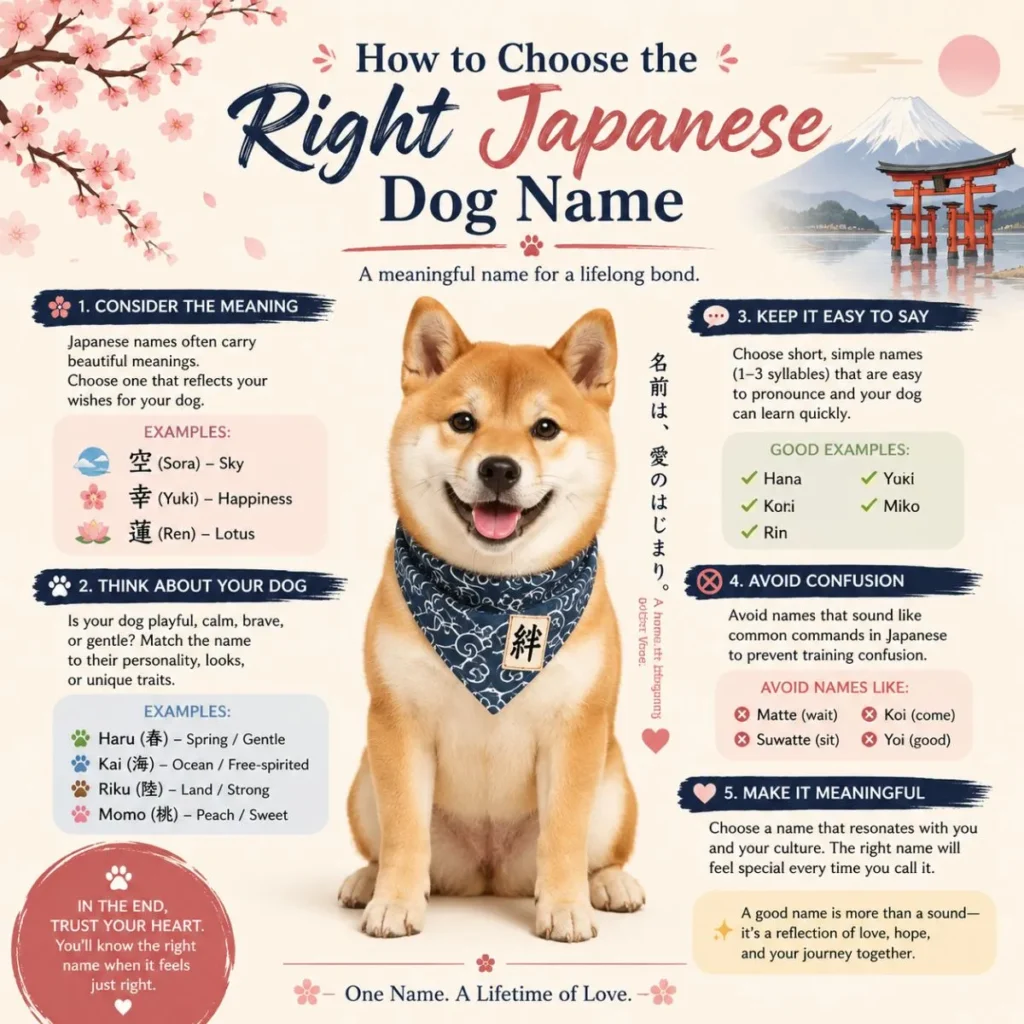
Overview: Follow a simple process to pick the best name.
Choosing a name takes time. Don’t rush. Try these five steps for great results.
First, watch your dog’s behavior. Is your dog playful or calm? Fast or slow? Match the name to their energy. “Kaze” (wind) for a runner. “Yuki” (snow) for a calm white dog.
Second, test the name out loud. Say it ten times quickly. Does it feel natural? Does your dog react? Avoid names that sound like commands. “Kai” sounds like “stay” or “lie down” in some accents.
Third, keep it short. One or two syllables work best. “Hana” is good. “Hanako” might be too long for daily use. You can use a longer formal name and a short call name.
Fourth, check the meaning. Some Japanese words have multiple meanings. “Kami” means paper or god or hair. Know which meaning you choose. Respect cultural significance.
Fifth, get family approval. Everyone should like the name. You will say it thousands of times. Make sure you feel happy saying it.
Mistakes to Avoid When Naming Your Dog in Japanese
Overview: Common errors that can confuse or embarrass.
Some names sound funny to native speakers. Others are hard to pronounce. Avoid these pitfalls for a better experience.
Do not use “Kun” or “Chan” in the name. These are honorifics for people. “Taro-kun” is not a real name. Just “Taro” works fine.
Avoid random word combinations. “Sakura Hana” means cherry blossom flower. It is repetitive. Pick one beautiful word.
Do not use negative meanings by accident. “Shi” means death. “Kyu” can mean nine or suffering. Check a reliable dictionary. Ask a Japanese speaker if possible.
Never name your dog a human taboo name. “Akuma” means devil. “Baka” means fool. These are insulting. Stick to kind and neutral words.
Be careful with pop culture names. Some anime names are silly or vulgar. Watch the show first. Know the character’s personality before naming.
Tips for Teaching Your Dog Their New Japanese Name
Overview: Help your dog learn their name quickly.
A name means nothing if your dog ignores it. Use these training tips for fast learning.
Start in a quiet room. Say the name in a happy voice. When your dog looks, give a tiny treat. Repeat ten times per session. Do three sessions daily.
Never say the name in anger. Your dog will associate it with fear. Always use a warm tone. Pair the name with good things like meals and walks.
Use the name often during play. “Come, Hana!” “Good Hana!” This builds positive connections. Within a week, your dog will turn their head when called.
If your dog already has a name, transition slowly. Say both names together for a few days. Then drop the old name. Be patient. Dogs learn new sounds at different speeds.
Frequently Asked Questions
What is the most popular Japanese dog name?
The most popular Japanese dog name is “Mochi” for small dogs and “Kai” for larger dogs. “Sakura” also ranks very high among female dogs. These names have topped Japanese pet surveys in recent years.
Can I use a Japanese name for any dog breed?
Yes, absolutely. Japanese names work for any breed. They are not reserved for Akita or Shiba Inu. A French Bulldog named “Mochi” is just as cute as a Japanese breed with the same name.
How do I know the correct meaning of a Japanese name?
Meanings depend on the kanji characters used. The same sound can have different kanji. For example, “Yuki” can mean snow or courage. Look up kanji on reliable dictionary sites like Jisho.org. Or ask a native speaker.
Are Japanese dog names hard for English speakers to pronounce?
Most are very easy. Japanese sounds exist in English too. Say “ka,” “sa,” “ta,” “na,” “ha,” “ma,” “ya,” “ra,” “wa.” Avoid rolling your R’s. Practice with a free online pronunciation tool. You will learn quickly.
Should my dog’s Japanese name match their personality?
It helps but is not required. Some people choose ironic names. A giant dog named “Chibi” (tiny) is funny. A lazy dog named “Hayate” (swift wind) is also amusing. But matching the name to personality often feels more natural.
Can I give my dog a human Japanese name?
Yes, many dogs share human names in Japan. “Haru,” “Hana,” “Ren,” and “Sora” are common for both people and pets. There is no strict rule against it. Use any name you love.
What is the best length for a Japanese dog name?
One or two syllables is best. Examples include “Ai” (love), “Kai,” “Mo,” “Reo,” and “Rin.” Three syllables can work too, like “Sakura” or “Haruki.” Avoid four or more syllables for everyday use.
Do Japanese dog names have good meanings for protection?
Yes, many do. “Mamoru” means to protect. “Kengo” means strong and healthy. “Isamu” means courage. “Shugosha” means guardian, but it is long. “Kishi” means knight or rider. Choose any of these for a protective dog.
Conclusion
Japanese dog names offer beauty, meaning, and variety. You can find a name for any personality or breed. Short names like “Kai” or “Mochi” are easy to use. Traditional names like “Taro” honor history. Nature names like “Sora” feel peaceful.
Remember to say the name out loud before deciding. Test it with your dog. Watch their reaction. A great name fits your dog’s spirit and makes you smile. Take your time. Enjoy the process. Your loyal friend deserves a name full of love.
Whether you choose “Hana” or “Raiden,” own it with confidence. Japanese names sound special without being strange. They are simple, clear, and full of heart. Start using your new name today. Your dog will thank you with wagging tails and happy barks.
Read more related articles on NamesHubX.com.

Sophia Reed is a content writer at Nameshubx, passionate about discovering unique, stylish, and meaningful names. She shares creative naming ideas and trends to help readers find the perfect name.